Monday, 6 May 2013

Video - Porsche 991 GT3: Ich Liebe Rennsport!

23/4/13, 0:53, 57433 views (when posted)

So the Porsche 911 Turbo is out, in case you hadn't noticed. In fact, if you hadn't noticed, then scroll down! It's their tech-fest 911, as is usual, but unusually, the pure and stripped GT3 has gained some big bits of technology as well, and in the process has lost the clutch pedal. Moan. But still, with a race-tuned PDK that lets you engage neutral by hitting both paddles at once - thus initiating a drift if you do it into a corner - it's not all bad. Especially when the new 3.8-litre naturally aspirated DFI engine revs to 9000rpm, which is unprecedented in a 911 road car. It's like a German 458! Press play with the sound up.

And if the wailing flat-six is still being drowned out by your inner car fan moaning about change, let "Mr. GT3", Andreas Preuninger reassure you that it's all for the better. He would know, having developed every 911 GT3.

4/3/13, 18:09, 301975 views (when posted)

Still not convinced? Then your only two options are to drive one or revel in the fact that 997 GT3s will be cheaper very soon. But as the outgoing car is being regarded as the end of an era, chances are they won't be for long...

Friday, 3 May 2013

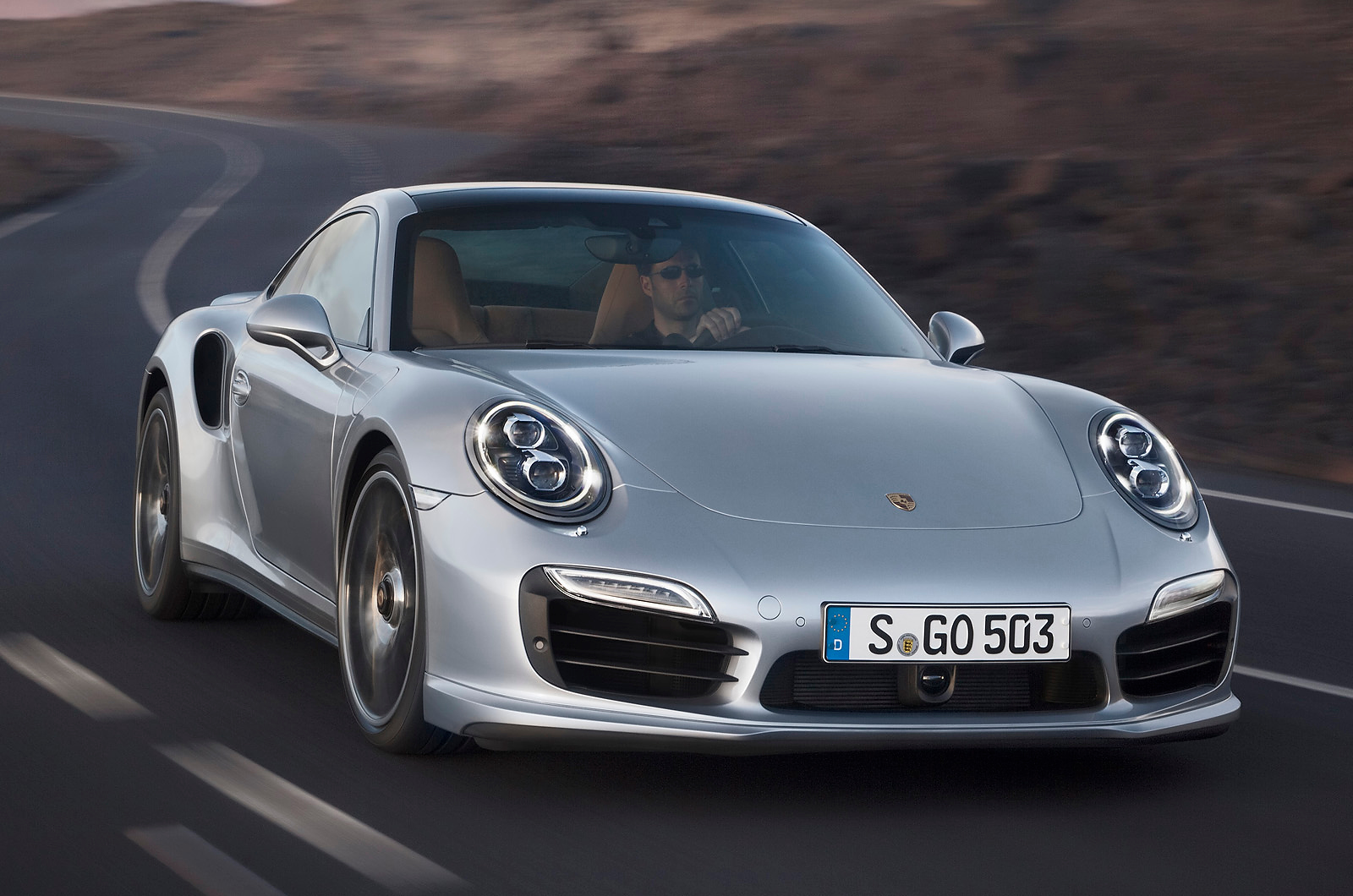
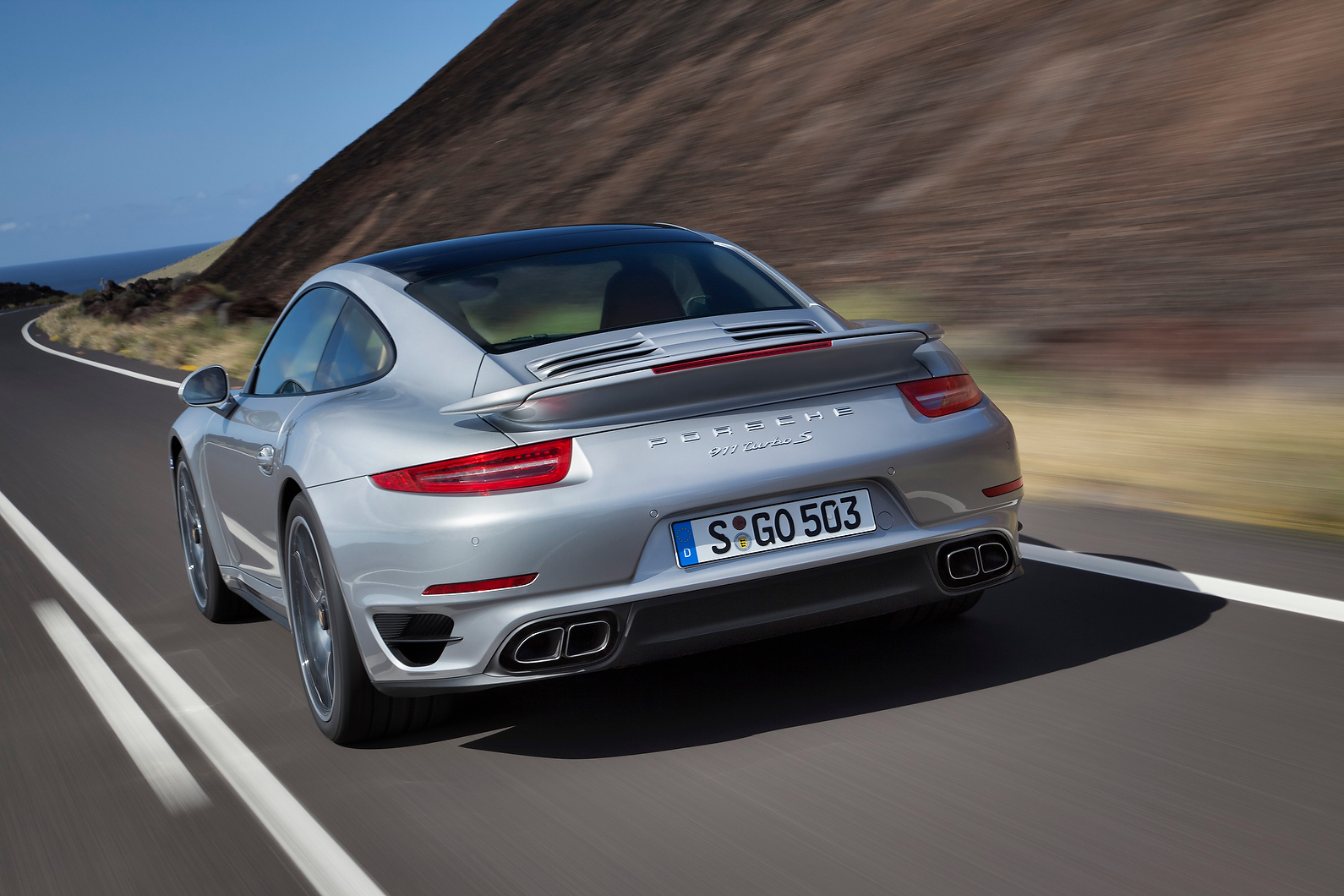
Porsche 991 Turbo: Ich Bin Ein GT-R

LED-only lights from the GT3 are a clue that this car is part of the new age
The Porsche 959 supercar of the late 1980s showed what was possible for sports cars with technology of the time. Sequential twin-turbocharging, active all-wheel-drive, adjustable suspension settings, the lot. Plus it could do 198mph, although that was famously beaten by the bare-bones 201mph Ferrari F40. In the years that followed, the 911 Turbo, previously the reserve of suicidal yuppies, has come to be the spiritual successor of that landmark supercar, with the three features I mentioned appearing in the forced-induction variant at a less stratospheric price since the 993 Turbo of the mid-90s. With the Nissan GT-R returning in 2007 to ruffle Weissach's feathers and show the critically acclaimed 997 Turbo the way home, Porsche's subsequent constant battle has just stepped up a gear with the new 991 generation. What's clear is that this is not necessarily a car for purists, but that by no means is to say it's not for fans of driving. In its 40th year, the 911 Turbo just went to the next level.

Seeing as this has become their techno-performance car, we should cover the improved or newly-added technology involved here. Oddly, the GT3 - previously the antithesis to the Turbo with its natural aspiration and rear-wheel-drive - has also been lavished with the kind of German techno-wizardry that Kraftwerk could merely dream of, so the Turbo had to go even further. Let's break this down into individual mouthfuls.

First off, it's only available with the 7-speed Porsche Doppelkupplingsgetriebe (PDK), which is German for Porsche double-clutch gearbox. Like I said, not necessarily a car to show the kind of 911 fan who still rues the change to water cooling. The justification for this is that no more than 10% of 997 Turbo buyers asked for a manual transmission, so why go to the lengths to offer and supply a trans' that at least 90% of your target market aren't interested in? Besides, it's widely accepted that PDK is the best dual-clutch 'box of the bunch.
I can't seem to find out whether it's the new bespoke sports-tuned PDK made for the GT3, so it probably isn't. In the GT3 they've made a bespoke version with gear changes made to feel like a racing sequential 'box, and the ability to engage neutral by holding down both paddles at once. Do this for a short time to essentially do a "clutch kick" and whip the tail out into a corner... if you're brave.

Secondly, for the first time it now has active rear-steer. Connected to the rear wheels are a pair of electro-mechanical actuators, which can steer the rear wheels by up to 2.8° depending on how fast the car is going. Under 50km/h (31mph), they steer in the opposite direction to the front wheels, effectively shortening the wheelbase by 250mm, or in other words drastically improving the turning circle at low speeds. Above 80km/h (49mph), the rears steer in the same direction as the fronts. This might sound like the car would crab diagonally, but remember of course that the rear wheels only rotate a very small amount, so actually it's more like the rear end tucking in when it would normally be in danger of starting to swing out in a fast bend. Porsche say it effectively lengthens the wheelbase by 500mm. So with this system you get the wheelbases of a Porsche 991 in a straight line, an original 901 at low speeds and a Panamera (slightly longer in fact) at high speeds. It's the best of all three worlds!
We'll just quietly ignore that such a system has previously been available on a Honda Prelude and a version of the Nissan Serena. Or even the '90s GT-Rs...

Next up is the appearance of Active Aerodynamics. Now, previous 911 Turbos have had pop-up spoilers to increase downforce and stability at high speeds, but when it was up it was up, and when it was down it was down. The new spoiler can be half way up so it's neither up nor down. In fact, much like the McLaren 12C, it has three positions. In the Turbo they're called Start, Speed and Performance. In Start, which it may surprise you to know is the default position, it's retracted and out of the way. In Speed position, it rises halfway up once you get past the traditional Porsche pop-up speed of 120km/h (~74mph). In the Performance position - activated by the sport button - it's fully raised and angles at "up to" 15°, suggesting it can fine-tune itself based on many sensory inputs.

But it gets much, much cooler than that...

The camera is most likely some kind of radar cruise control
Working in conjunction with the pop-up wing is a front spoiler. But not just any front spoiler, an inflatable front spoiler! Just like the wing, this elastic material designed to resist road rash starts fully retracted, but can inflate halfway after 74mph or all the way out in Performance mode, at which point every keen-eyed person will see whether you've got a Turbo or a Turbo S (more on that in a mo). Together the elastic splitter and rear wing generate 140kg of downforce at speed - which is a lot - while increasing stability all the more as a byproduct. This is an inspired idea. We've had cars with retractable front spoilers before, such as the Toyota Supra Mk.IV, but they used a solid piece that would break and be notably more expensive to fix or replace than a fixed lip spoiler. If you're wondering how it inflates, Porsche calls the front spoiler "a flexible, pneumatically extendable elastomer". So it's not like a balloon.

Pushing you up to and beyond those speeds is, as usual, a rear-mounted flat-six engine, with twin turbochargers. However, unlike the 959 (but much like the outgoing 997 Turbo), instead of sequential twin-turbocharging, where one is at a lower pressure than the other, thus coming on boost earlier to reduce lag, the new car uses "Variable-Geometry Turbines." Small computer-controlled vanes adjust based on engine speed, so they effectively become small turbos at low RPM, and big turbos at high RPM, at which point they're helping the 3.8-litre Direct-Injection engine produce 520PS (513bhp) at 6000-6500rpm, or 560PS (552bhp) between 6500 and 6750rpm in the Turbo S. The torque figures are more impressive; the regular Turbo delivers 487lb/ft from as early as 1950rpm, with an optional Overboost feature temporarily boosting that to 524lb/ft by increasing boost pressure by 0.15bar (2.17psi). Amazingly, at full throttle the Turbo S produces 516lb/ft of torque all the time. I'm not aware of another car that does that. Overboost - only available with the Sport Chrono package, which is standard in the S - punches that up to 553lb/ft of twist. That should be enough!

What do these figures mean? More figures, of course! The standard Turbo can do 0-62mph in 3.4 seconds and top out at 195mph, while the Turbo S cuts the acceleration time down to 3.1 seconds and matches the 959 at 198mph. All very impressive, but not quite as impressive as the 2013 Nissan GT-R's mind-bending 0-62 time of just 2.7 seconds...

Oh, and they've said it'll lap the Nordschleife in "under 7:30", but lots of cars with this kind of performance claim to do that now. The GT-R will do it in around 7:18 if you're a good enough driver, so that's their target.

Anything else? Well there are the headlights. Included in the "Sport Chrono Package Turbo" options pack - along with a timer on the dashboard, a "Sport PLUS" button, carbon ceramic brakes (PCCB), dynamic engine mounts to reduce vibrations and Porsche Dynamic Chassis Control, i.e. active dampers to help keep the car level but smooth - is Porsche's Dynamic Lighting System Plus. This works in two parts. First of all, each headlight unit comprises of 60 LEDs, separated into a pair of light housings. Light bulbs are so last decade, people. Secondly, the lower light housing swivels, so you can see the inside of the corner you're on at night, while still having a straight beam of light to see everything else.

The swivelling-headlight thing is all well and good though - we've seen that on many cars, with the first of them being the Citroën DS - but the use of multiple LEDs adds a third dimension, as "dynamic high beam control" detects the lights of cars approaching or in front of you, and then adjusts the brightness of each diode to make sure you don't dazzle other drivers. This had better work, as LED headlights are bordering on being arguably too bright these days. I wouldn't trust this to work perfectly all the time, but it's still a very clever new feature that will most likely become widespread over the next 5-10 years, perhaps evolving to the point where we no longer need a switch for high and dipped beam. This element of the lighting system activates above 37mph, making yet another way in which this car evolves as it changes speed. Talking of seeing, the new deeper bumpers on the Turbo version incorporate nicer LEDs on the front than the standard car, whose minor lights hang over the edge of the outer air vents.

Other miscellaneous features include a "Sound Symposer", which channels the engine noise through tuned pipes and into the interior, as well as Auto Stop/Start to reduce emissions, which combine with computer-based engine system optimisations and improved "thermal management" to reduce CO2 emissions by 16% over the 997 Turbo. It also has a combined fuel economy figure of 25.3mpg. Not that you're really bothered about that...

Like all new Porsches since the dawn of the 991 a year ago, the Turbo uses electro-mechanical steering. This annoyed purists because the word "electric" is involved, and road testers complained of a loss of feel over bumps over the old, less efficient steering system. Thankfully, they seem to be improving it all the time, with the Cayman S getting almost nothing but praise using essentially the same system. Pinpoint accuracy is still something Porsche does very well, so with further evolutions in the steering system here, it's probably better still, although there is the all-wheel-drive (which is updated and now water cooled) to consider.

So as you've read, there's a hell of a lot going on under the skin of this car, and even on it. And yet, thanks to more aluminium in its construction, it's actually lighter than the previous car. Modern technology, eh? So what does this neo-959 cost? In the UK, the standard Turbo starts at £118,349 and the Turbo S at £140,852. The Turbo S's only mechanical difference is the added oomph in the engine. The rest of the price gap is the standard inclusion of the Sport Chrono Turbo pack and probably just a dash of extra cash so you can boast about it to the Joneses. If liberal usage of technology's not your thing, then, er... there's not a lot you can do about it actually. The £100k 991 GT3 also uses the rear-steer system and standard PDK, much to the bane of internet purists who can't afford one. There's the counterargument that the racer-like gearbox and the 493bhp engine's searing 9000rpm redline are both nods to driving enthusiasts and Porsche fans, but at the end of the day, if you want simplicity and a manual gearbox, you'll have to sink all the way down to a basic 345bhp Carrera 2, and even that uses seven gears.

It's the 50th year of the Porsche 911, not to mention the 40th year of the 911 Turbo, and it's easy to see that, for a number of reasons, it's not going to be a quiet one.

Pictures below:

Two tiny grooves in the bumper are new, and probably cut drag by a teensy amount.
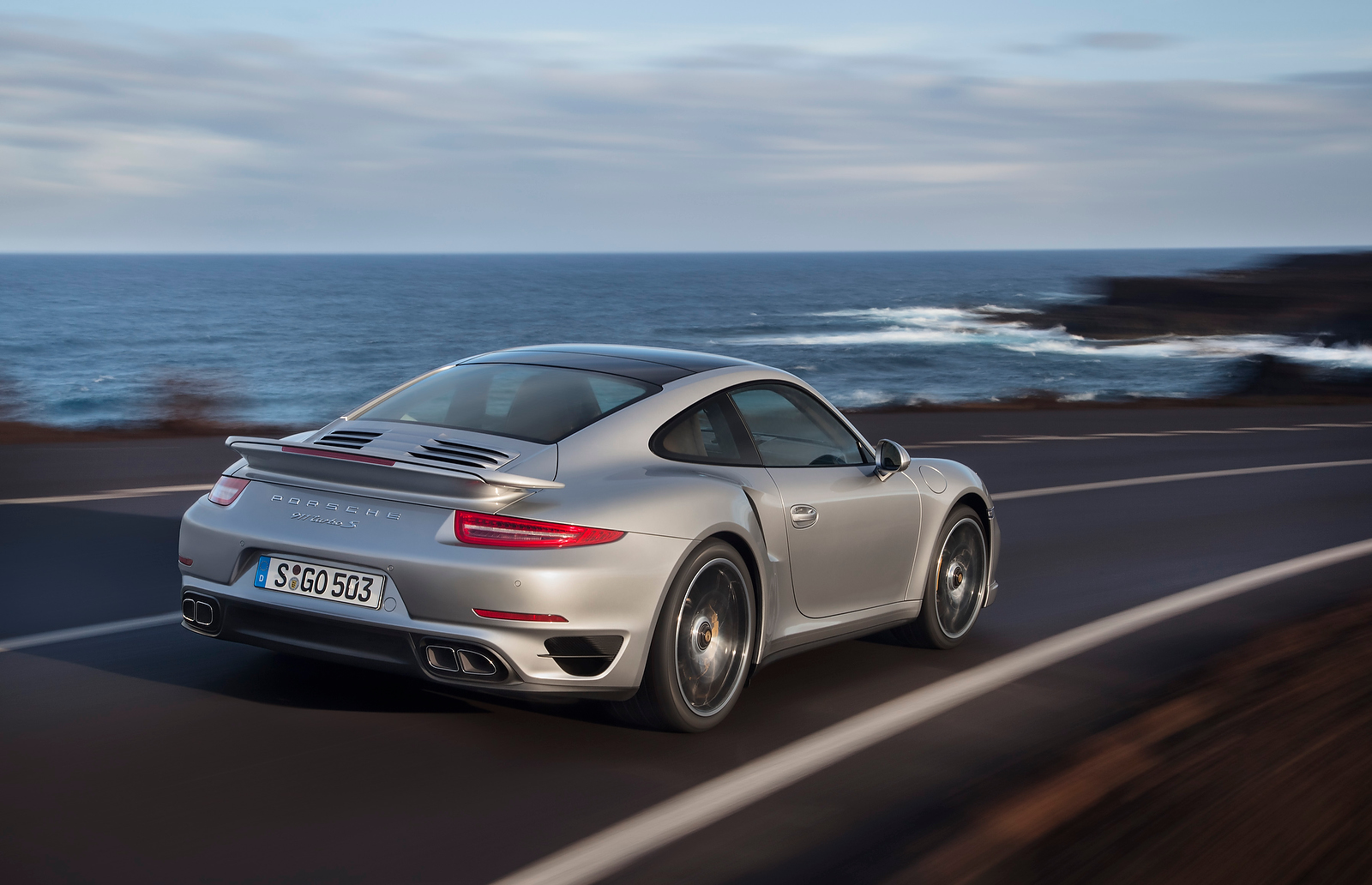
Thanks to superfly, super-flared rear arches (and 20" wheels to fill them), the Turbo is 28mm wider than the Carrera 4.
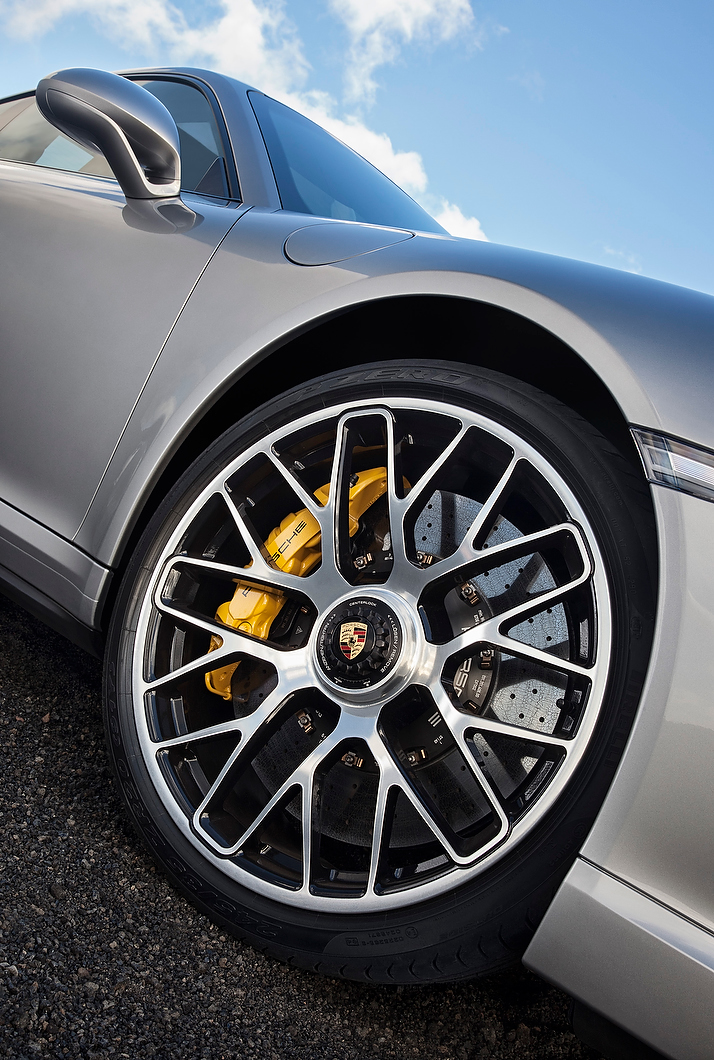
New 20" Turbo S wheels are awesome, and a nice play on the traditional BBS Le Mans-style wheel, with a GT3-esque centre nut.
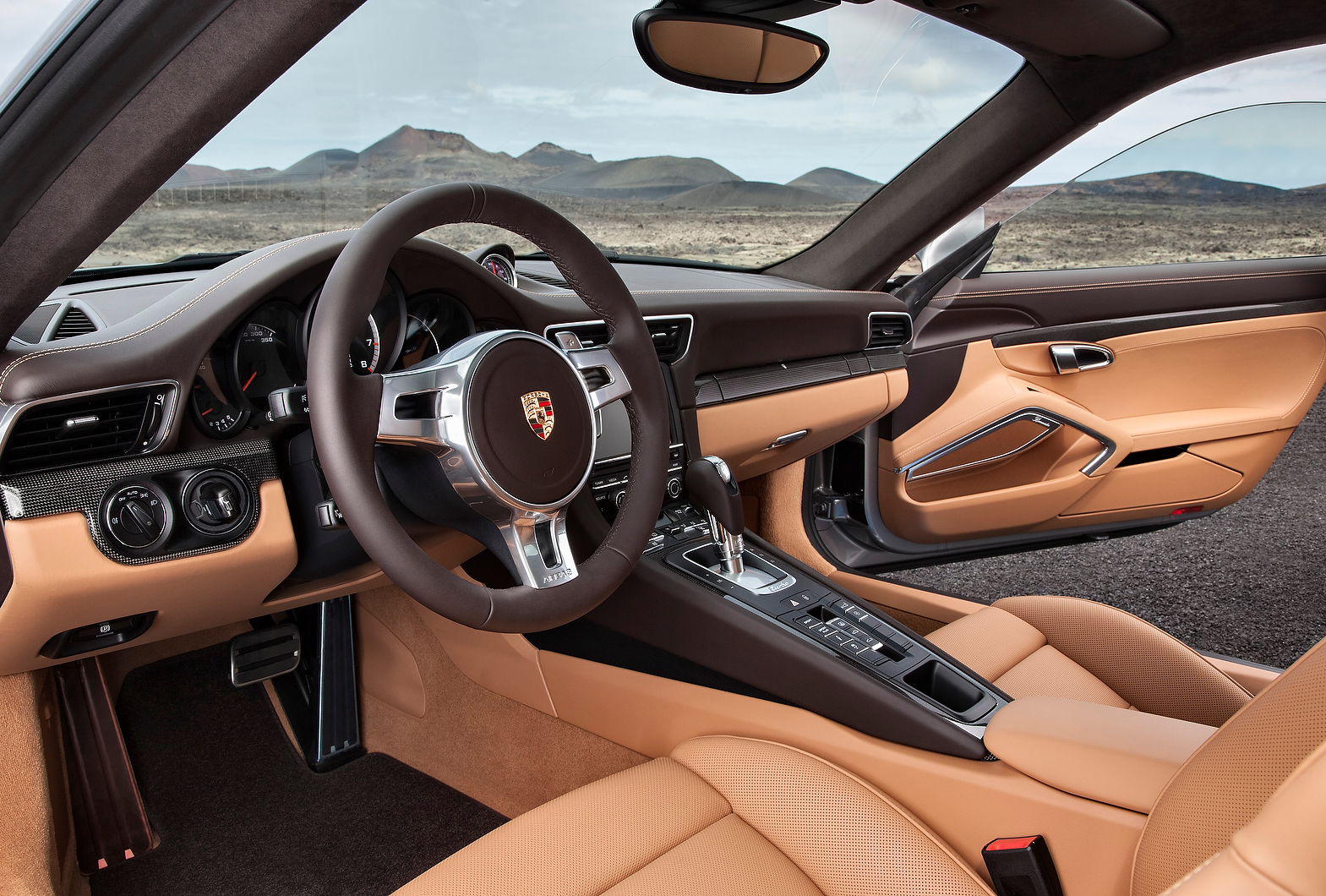
Hmm, not sure I'd spec coffee-on-fake-tan myself, but then Porsche's configurator shows that they're good at gaudy interiors...
Rear wheelarches are so flared on the Turbo that they're almost flat. I'm not sure I like the rear view yet. It just looks too... fat.
These things tend to work better in person though, so I'll reserve judgement until the Goodwood FOS, when it'll likely appear.
Thankfully, Walter specified the Turbo S, meaning his carbon ceramic brakes stopped him in time without fading. Close one...
Last shot of "dat ass", as the internet puts it. It actually doesn't look bad from this angle. It just needs less grumpy tail lights.
UPDATE (8/5): Oh hey look, a video! See the spoiler in action for a split second!


More Porsche 911-based content to follow. At some point. I'll be freer to write in June, so expect a wave of posts then.

Tuesday, 30 April 2013

Road Taster: Jaguar XF 3.0 Diesel S Premium Luxury

Our driveway rarely looks so small...
I sometimes get the impression that, in a small way, I was destined to be a petrolhead. Wherever I look, an enthusiasm or involvement with cars is in my family. My dad was and is an avid follower of Formula 1, one family member was a driving instructor, one (RIP) engineered parts of the 1960s Comet commercial jet, another was a traffic policeman for a long time. Cars family members own include a Ford Sierra RS Cosworth and XR4x4, Audi S4 Avant (B5), and formerly a Honda Fireblade, which is an unusual two-wheeled car featuring leather human trim. Then there's my Grandma and her Jaguar fandom. I like to think I was the trigger for this; during a visit to our house many years ago, I'd just got a model of a then-new S-Type, and was looking at it on the table when she walked in and immediately took an interest.

A while later, she'd test driven one and found she had to scale down to a then-new X-Type (2.0 Classic). The car community may scoff at the Mondeo-based X-Type, but as it was her first Jag (replacing her second Rover 820 liftback) it didn't bother her in the slightest, especially as (almost) everything one saw and touched felt very Jaguar-ish. After that she wouldn't look at another car brand for long, and enjoyed the occasional looks of bemusement from onlookers seeing a woman driving a Jaguar, not to mention the local dealer letting her take other models for a spin once in a while. A couple of years later she got the S-Type she always wanted (a 3.0, no less) and loved it, nicknaming it "Lady Jane". Alas, changing from a 2.0 four-pot to a 3.0 V6 was always going to make a difference to fuel economy, so a manual-equipped Fiat Panda Eco acted as grocery-getter (thank you scrappage scheme for not letting that be a grey Vauxhall Astra Mk.III). The S-Type was a beloved companion for longer than the X. But you know how it is. Sometimes you feel like doing a spot of window shopping. Maybe you even get to test drive the replacement model. And maybe everything about it's lovely...

And so here we are, in 2013, with Jag number three (like the S-Type, it's second-hand, but this one is nearly new). With fuel economy in mind, this one's the highly-commended 3.0 Diesel S, which adds a pair of turbochargers and more than a pair of miles per gallon to proceedings. Yet with 240 horsepower and a meaty 370lb/ft of torque propelling an entirely aluminium car, it's no slouch. 0-60 takes 6.7 seconds, level with the brand new Renaultsport Clio 200 Turbo, and the top speed is a heady 140mph. On the flip side, the claimed economy figures are 46mpg (combined) and 159g/km of CO2. Not bad at all for an executive car with a V6. Grandma was convinced it was a smaller car than the S, because her umbrella no longer fits across the tailgate, but that's a deception caused by the XF having wide hips. The cost for all this loveliness? Well, spec'd with the options she mentioned (bluetooth and blindspot monitors) it was pant-wettingly close to £50,000 when new. What they're worth with part-exchange when they're one year and 6000 miles old, I don't know, but I'm hoping it's considerably less than that...

Anyway, the reason I'm telling you this, aside from pointing out that I have cool relatives who love cars too, is because over Easter, she popped round in the new Jaaaaaag and persuaded me to take it out for a spin. At first I was apprehensive. I've driven big expensive cars before - most notably a Nissan GT-R - but those were all on airfield circuits with a trained professional riding shotgun telling me what to do. To drive something with three and a half times the power that's significantly longer in wheelbase and worth probably ten times more than my Grande Punto (plus a great amount of sentimental value to my passenger) on the road, where people who don't care are driving, well, you can hopefully see my concern. Still, I didn't want to be "that guy" who turned down the opportunity of a go in a nice car based on wimpy-ness. So I obliged on the proviso that I picked a route I was comfortable with.

Yup, it's beige-on-beige. But it works a lot better than that makes it sound like it does. Touchscreen easy to decipher.
Early in the morning on a chilly April Fool's Day (no joke), she drove me up to the local pub and we swapped places. The heated seats were relatively easy to adjust, although being electric it takes a shade longer than manual seats. This was the first time I'd ever driven an automatic car on the road. With your foot on the brake, press the pulsing starter button and the diesel engine fires up with quiet refinement, at which point the gear selector rises out of the centre console and the air vents swivel round in their Thunderbirds way. Perhaps the heartbeat starter and swiveling vents are a gimmick, but I say they add some occasion to starting your car up, and that's no bad thing. Foot still on brake, twist the gear selector from P to R, at which point the radar sensors come in and a display appears on the TFT screen (which looks good and is easy to navigate), and reversing wasn't so intimidating after all. I had to remember that the nose is much longer, but spacial awareness was telling me it's a big car anyway.

Having pulled out without issue, what struck me quickly was how smooth everything was. Silky is the best work I can think of to describe it, as everything's so smooth and effortless. That said, the 19" wheels do still tell you what the bumps in the road are doing, but each impact is nicely dampened by the, er, dampers. I'd decided to take it on a shortened version of one of my first driving routes I discovered in the Punto, which goes through trees and over hills, almost entirely at the national speed limit. It's quite easy, not very well-sighted but, crucially, always wide enough. To get there from the pub though, there was a tricky mini-roundabout. I didn't factor in the long wheelbase and the inside rear wheel was within inches of the kerb, but thankfully no contact. Phew!

Above all else, the acceleration is just so effortless. We wafted up to 40mph, then got to the bit where we can go 60. In the Punto, I like to drive past that magic sign in 3rd gear, pin the throttle and let the revs surge gradually climb past 4000rpm before changing into 4th, then going into 5th quite soon after to avoid going 70mph. It's noisy and takes effort. In the Jag? It just sort of happened. With a tighter squeeze on the throttle, you feel it pick up quite quickly and before you know it you're doing 60mph. It was as though all the engine had done was taken a deep-ish breath and we were there. I'm not even sure there was a gear change, although there could well have been. I'd told myself I would use the little short-travel, wheel-mounted paddles to try them out, but honestly when I was actually driving the car it didn't occur to me to use them. The ride felt so smooth without making the car seem disconnected from the road, and the steering did the same trick.

The journey basically continued in this vein, with the oil-burning XF's V6TT never feeling sluggish and always feeling like it could do more if you wanted it to. Part of me did, but would you go speeding with your grandmother watching? She told me afterwards that I peaked at 67mph - probably going downhill from the bridge over a dual carriageway - which I probably shouldn't admit is not the fastest I've been on these roads...

So what's the XF like then? Effortless. It makes the Punto seem coarse, slow and loud. Almost archaic, even. But then at nearly £50,000 new compared to a hatchback we bought for £5300 that's now worth about half that, you'd hope it would really. Still, I'm struggling to think of any flaws, except that when I did flick the paddles before turning the engine on, they felt a bit naff. They're also too small and almost apologetic about their presence. But like I said, you feel no need to use them. Did I miss the clutch pedal? No. That would've affected the smooth driving experience. If it was my only car, I suspect I would miss changing gear, but I'm well aware that it'll be a long time yet before I'm faced with that particular conundrum.

I hope Grandma holds on to this car. Partly because she might let me have another go in it, but mostly because she absolutely adores it, and from what I can tell it's a great car. She maintains that the fact that the rear looks like an Aston Martin is a good thing, and so do I when it along with the whole car looks that good. Even in beige. I mean, er, Cashmere.

Friday, 26 April 2013

An Anecdote Regarding Enzo Ferrari's Favourite Car Design

I've seen hundreds of pictures and seen the E-Type in person maybe a dozen times, but when I was at college a year ago (as in the bit before Uni), I had to go to the V&A museum for an exhibit about British Design. It was all interesting enough, but not particularly so. I rounded a corner and entered the second room, and there it was sitting right in front of me, an utterly immaculate metallic grey Series 1 coupé, seemingly out of the blue.


I stopped in my tracks. An involuntary grin upon my face, I made that hot breath "oooh" sound. I had to. It was utterly mesmerising. I spent what must've been 10 or 15 minutes just walking around it, drinking it all in, looking at every detail (it was Italian-registered). When I eventually urged myself to look at the other exhibits I would always try to catch another glance across the room.

Aside from my previous familiarity with E-Types, I can't help but imagine this must've been the effect it had in 1961, when nobody had seen it before. When you don't expect to see one and you're presented with such an example, you are a goner, mere putty in its hands. If a woman ever invokes this reaction, I would be too nervous to talk to marry her.

Happily, the internet has pictures of all the things. The effect is better in person!

Saturday, 13 April 2013

Formula 1 2013: So You've Had The Intro...

The first corner of 2013
So, after a long wait, the Formula 1 season came back for a fortnight before disappearing off again for three weeks. If you don't actively keep up with F1 news, then there may have been many confusing things at these two races. Where are those white cars that always come last? Why is Lewis Hamilton now Mexican and Michael Schumacher now a mixed-race Senna fanatic? How come some of the cars don't have stepped noses like last year? And who are these new people I've never heard of? Fear not and settle down, for to make up for the lack of a season preview, I shall answer your bewildered questions now.

And Then There Were 22
Hispania Racing Team (HRT) were one of the three new teams that joined the sport in 2010 to make an 18-car grid into a 24-car grid. They started out with a mostly-grey livery that looked... true to their budget. Their drivers, Bruno Senna and Karun Chandhok, had had so little opportunity to test the car that Chandhok's first ever drive in a Formula 1 car was actually the first qualifying session of the season! Later on that season, a season in which they either broke down or came last, the drivers seemed to be interchangeable, with ex-Super Aguri driver Sakon Yamamoto hopping into the car for the odd race here or there. When he had food poisoning at the Singapore GP, rather than letting Chandhok back in the car, they found a fourth bloke, Christian Klien, who nowadays drives for Aston Martin Racing in sports cars. The "F110" was almost slower than GP2 cars, let alone its F1 opponents...

In 2011 they at least looked the part, with a flashy new livery by Daniel Simon, he of Cosmic Motors, Tron: Legacy and Captain America design fame. With Senna and Chandhok fleeing to Lotus-Renault and Caterham respectively, they had to find new drivers, and found Vitantonio Liuzzi - formerly of Force India - and Narain Karthikeyan, who brought with his Indian self some sponsorship from automotive giant Tata and... nobody else. In fact, the almost self-parodying livery had to fill space by pointing out where sponsors could go if they wanted. Few obliged. They were closer to the Marussia team, but still a laughing stock who generally either broke down or came last. In fact, their slowness the year before had brought back the 107% rule, which enforces a minimum lap time based on Pole Position's time. In the first race of the season, both cars failed to meet it. They managed it from then on, though. The only fun they could have was in blocking the front runners, something at which Karthikeyan showed particular aptitude. He gave up his seat to Daniel Ricciardo for the last 10 races minus his home Grand Prix.

After failing to qualify for the Australian Grand Prix again, 2012 actually saw them finally being competitive... with the other bottom teams. Should it be considered an achievement to qualify 20th? I'm not so sure. Still, it was progress for a team that was still so cash-strapped that I'm pretty sure they didn't ever have KERS equipped to their cars. Karthikeyan finally had a seat all to himself, as did Spanish veteran Pedro de la Rosa. They either came last, came second-to-last if Marussia (who also lacked KERS) had had a bad weekend, broke down or Karthikeyan crashed. At the Abu Dhabi race he broke down in front of Nico Rosberg, who crashed over the top of him and out of the race, while earlier on in Malaysia, he had held up Button (breaking his front wing) and Vettel, who got a puncture, retired from a competitive position and responded by calling the Indian an idiot and a cucumber. Seriously. I'm not quite sure what he meant to say, but he nevertheless had to apologise for his puzzling remark. HRT's highest finish last season was 15th place, at the prestigious Monaco Grand Prix. How many cars finished the race? Yup, 15.

By the end of the season their continued existence was in doubt, and sure enough, they went bankrupt and disbanded not long before 2013 testing began. When you're best-known for coming last, you don't tend to attract investors. De la Rosa became Ferrari's test driver, while Narain Karthikeyan took too long to get to the airport and held everyone up, before walking straight into a security barrier and then breaking down. Just kidding, he's now competing in something called Auto GP for a team called Zele. Sounds made up to me...

New Faces, Or Just New Clothes

Top Row (L to R): Max Chilton, Jules Bianchi, Giedo van der Garde, Charles Pic, Daniel Ricciardo, Jean-Eric Vergne.
Middle Row (L to R): Valtteri Bottas, Pastor Maldonado, Adrian Sutil, Paul di Resta, Esteban Gutierrez, The Hülk, Lewis Hamilton, Nico Rosberg.
Bottom Row (L to R): Romain Grosjean, Kimi Räikkönen, Felipe Massa, Fernando Alonso, Sebastian Vettel, Mark Webber, Jenson Button, Sergio Pérez.
There's been some reshuffling as usual this year. The high-profile move was of course Lewis Hamilton leaving McLaren to go to Mercedes-Benz's works team (formerly Brawn GP), thus doing the exact opposite of what Jenson Button did after 2009. After 13 years of McLaren he needed a change of scenery, and even being offered more money by the British team couldn't stop him. He's now racing with his best friend like they did 13 years ago, which is kind of sweet, actually. He also got a dog called Roscoe, to match his bitch call-- actually, let's not do that...

Also jumping ship is Nico Hülkenberg, who has made a somewhat sideways jump from Force India to Sauber. Last year Sauber were slightly ahead of Force India and bothering the really big dogs, but there's no guarantee that they'll always be doing that. To fill the void at Force India, Adrian "The Glassman" Sutil joins Paul di Resta, who has been told to not look so miserable all the time by his manager, as it will increase his chances of moving to a higher team. Really.

"The Hülk" replaces Kamui Kobayashi, who sadly couldn't find a race seat despite raising over £1,000,000 from fan support. He's now racing in the new World Endurance Championship for Ferrari's GTE team AF Corse (hopefully he won't cause an accident with an LMP1 car at Le Mans...), while Sergio Perez's move to McLaren meant that Sauber needed a Mexican, and they found one in Esteban Gutierrez, their young test driver from last year. And by young, I mean he's 21 years old. Why am I not an F1 driver???! :-(

Frenchman Charles Pic, who started his career at Marussia in 2012, jumped ships to Caterham, a team who narrowly beat Marussia in the Constructor's Championship at the final round in Brazil. He's joined at Caterham by rookie Giedo van der Garde, who is literally Dutch. Rumours of his car having wooden pedals cannot be confirmed. What Sky F1 can confirm is that he's not very good at Really Big Jenga. Their presence means that neither Vitaly Petrov nor Heikki Kovalainen are in the sport anymore, which is a shame as Petrov's presence had prompted the creation of a Russian Grand Prix which now might not have a Russian driver in it, and Kovalainen was actually pretty good. Alas, what Caterham need is sponsorship money, to avoid doing an HRT and get the resources to try and develop the car to the point where it might actually score points. A sad reality of modern Formula 1.

Marussia now have an all-new driver line-up as well. Max Chilton, who raced for their GP2 team last year, is paired up with Jules Bianchi, Ferrari's young test driver from last year, whom Ferrari managed to find a race seat to get him some racing experience. They have KERS this year, so they should be competitive... against Caterham.

Lastly, at Williams, Bruno Senna has been booted after being average all season, and is now racing for Aston Martin Racing's GTE team in the WEC. So at least there'll be one familiar face for him! He's been replaced by Valtteri Bottas, who is a Finnish person. Well, if you want to win, employ a Finn. Or Maldonado (who's stopped hitting things now). Or both! Another noteworthy change at Williams is that Claire Williams, daughter of Sir Frank, is now Deputy Team Principle. This is important to the media because she's a woman and that alone is interesting in F1. That's why Williams' new test driver, Susie Wolff, has had a whole documentary made about her by the BBC (also because she's British and that's important to the BBC too).

So, Let's Take A Look, At Yo Brand New Whip


I've already posted about all the new cars except the Williams FW35, which took its sweet time getting here.

Red Bull
Ferrari
McLaren
Lotus (or do I mean LOLTUS???)
Mercedes
Sauber
Force India
Toro Rosso
Caterham + Marussia

As for the FW35, it's not really a very competitive car. This time last year, Maldonado had fought Alonso for a top-5 finish... before crashing, and they'd got more points than they'd managed to get for the entirety of 2011. By round 5, they even had a race win under their belts for the first time since Brazil 2004. Fast forward to today and they're lacklustre at most, with a grand total of 0 points. The Chinese GP tomorrow will see them starting the race in 14th and 16th. Not good...

Oh, and it looks like this. A combination of last year's car, a Coanda exhaust and a slightly Ferrari-ish nose.

Click to embiggen

Who Nose Why Some Are Still Crooked...
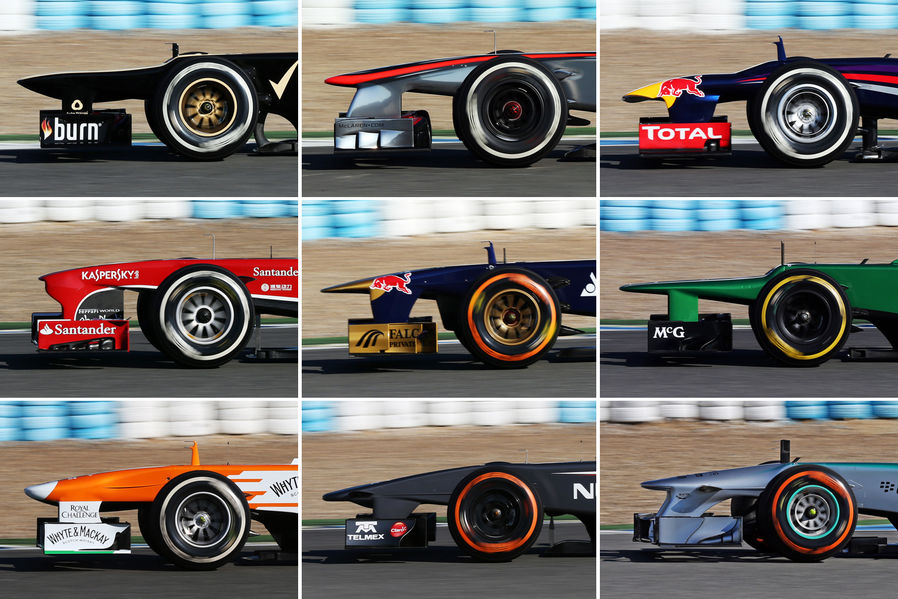
The 2013 Best Nose Competition. Williams and Marussia couldn't make it. Caterham (middle-right) will probably lose
OK, so if you were following last year, you'll know that the term "stepped nose" was on the vomit-stained tongues of Formula 1 fans everywhere 14 months ago. The designers want to use a high front chassis (thereby getting more air under the car to control around and under the main part of the car and on to the diffuser), but they'd got to the point where a T-bone incident could see the nose intruding on the cabin of the car it hits, so the FIA enforced a lower nose height, creating a step from one height regulation to another. McLaren avoided the unsightly new nose by making the whole front chassis lower, but soon found that a higher nose is indeed better, and so it rose a wee bit as the season progressed.

The barrage of fan complaints got to the point where the FIA decided to make an optional workaround for 2013. So now, teams can include a "vanity panel", which goes over the top of the nose to give a smooth shape. It can't be structurally integral, and it shatters into tiny pieces on impact. Curiously, every team used it except for teams powered by a Renault engine, those being Red Bull (well, they've got a half-length panel to save weight), Lotus and Caterham, that latter of which's nose is still by far the ugliest. Rumours abound on the internet that McLaren and Ferrari have found a way to make the actual noses higher than the regulations allow underneath or inside the Vanity Panel. It doesn't seem to be any major advantage, though, as it's just one aero element. Still, it's interesting to see the amount of variety in the noses, considering how similar many other big bits are from car to car.

Get A Grip Already!

Clockwise from the orange one: Hard, Medium, Intermediate, Wet, Super-Soft, Soft.
Pirelli have noticed that the first half of last season was so exciting and unpredictable because nobody really understood the tyres enough to optimise the cars for them. That gave us 7 winners in 7 races, the most varied start to a Formula 1 season ever. Clearly they're shooting for 8 in 8, because they've fiddled with them yet again, making every dry compound a little bit softer, increasing the operating window (theoretically) but still retaining that "cliff" people talk about when they lose grip very suddenly (the tyres, that is). Unfortunately, in Australia this lead to Super Soft tyres that only lasted about 5 laps, which to be honest is unacceptable. Hopefully this won't be a trend...

If you're still getting to grips (baddum tshhh) with even the basics of the tyres, then don't worry, because it's actually very simple. OK, it's fairly simple.

There are two wet tyre compounds, Intermediates and full Wet rubber. Inters are for light rain or a drying track, and don't have as much tread as the full wets. Drivers occasionally have to cool them down on drying tracks by going off-line and finding some standing water for them to work in. Full wets are for when the rain is properly Welsh and Intermediates simply aren't up to the task anymore. Unlike dry compounds, you don't need to use both types in a race and can just use what's best for the conditions.

There are four dry tyre compounds, but only two are taken to a race, and Pirelli decides in advance which ones go where. The four compounds are Super Soft, Soft, Medium and Hard. The softer the compound, the grippier but the shorter-lasting. It's quite tortoise-and-hare. Last year the Hard compound had silver graphics, but they were so hard to see that they've been painted orange this year. It's compulsory in a dry race to use both dry compounds at least once. To avoid confusion, the two compounds are referred to by teams as Option and Prime, with Prime being the harder tyre. To work out which colour is the Option or Prime, either pay attention to the graphics just before the start of a session or spot the compound on one car and then look for a softer or harder compound on another one. The softer one is always the Option tyre.


Anything Else I Should Know?

Well, the pecking order is largely the same as it was this time last year, as the cars are evolutions of the 2012 cars. Except for McLaren. Their MP4-28 has pullrod front suspension, and when Ferrari did that last year they had an awful start to the season as they got used to the different setup, which is essentially the normal pushrod setup but upside down. It lowers the centre of gravity and theoretically behaves better over bumps, but is harder to adjust and seems to require some differences elsewhere. So far McLaren have had an awful start this year, which is both surprising and disappointing as it's generally believed among those in the know that last year's MP4-27 was the fastest car of 2012 (when it wasn't in the pits, at least). This year looks more like the start of 2009 for the Woking outfit, and we all hope they improve a bit faster than the Ferrari did, as Jenson Button doesn't seem to be able to outperform his car like Fernando Alonso did his F2012 early last year.

Speaking of Ferrari, they've had a year to acclimatise to an all-pullrod suspension system, and despite their woes, Fernando's flawless season coupled with his team mate's return to form in the second half meant they pipped McLaren to 2nd in the Constructor's Championship last year. Now they have a car that works, and are generally at the sharp end of things. With Massa no longer the out-of-form whipping boy, he's actually outqualified Alonso four times in the last five races, with the chain just being broken at China.

Red Bull are still near the front, but not borderline-invincible like they were in 2011. Still, with aero magician Adrian Newey still designing their cars, you can never rule them out.

Mercedes started very well last year, but lost big time in the development race and finished the season fending off Sauber. This year they've started very well again, so with Lewis Hamilton pushing them to stay at the front, we'll have to see how they do in that respect this year.

Williams have also been a bit poor so far, as I've already mentioned, although the team really believe in Valtteri Bottas, so if and when they get their shit together, they could pull a Sauber and occasionally surprise like last year. On Sauber, they haven't been on the same form as last year either. Their apparently-radical C32 needs harmonising as well, it seems. Esteban Gutierrez hasn't been overly impressive, but it's only his debut season. Force India are still a strong midfield team.


Lotus are ever-present at the top of the grid nowadays, particularly Kimi Räikkönen. His team mate Romain Grosjean has stopped hitting things, but is also in the middle of nowhere results-wise. The "Enstone Team" is once again in a position where if they can qualify high, they'll be a shoe-in for a podium finish. This is partly thanks to their Front-Rear Inter-Connected (FRIC) suspension system, which sends hydraulic fluid fore and aft to keep the ride height constant and level - thus retaining aero balance - in corners without making the car as stiff as a skateboard. It's a bit like the system in the McLaren MP4-12C road car that gives it that magic ride quality, except that the 12C's system is active and computer-controlled, whereas the F1 cars that use it (currently just Lotus and Mercedes) need to use passive systems that work on their own, independent of the driver, to conform with the rules. Still, you'd think McLaren would've adapted their own system for track use...

The key advantage of FRIC suspension is that it makes the cars kinder on tyres, which has certainly helped the two teams in the first two races. We'll have to see if it becomes widespread.

So that's pretty much it! Enjoy the Chinese Grand Prix tomorrow.

Thursday, 11 April 2013

Things I Could've Written For April Fools' Day

Toyota ProAce BTVC Entries. Not

I'm back. To be honest, I was planning to be "back" sooner, but, well, I wasn't. That's pretty much how I roll. Anyways, I was going to write a joke article for April Fool's Day, but seeing as that was over a week ago, it would be rather pointless now and you would actually believe me. Car companies had fun, though. Toyota pretended it was entering its Proace van in the new British Touring Van Championship (which I'm sad to report does not exist at all), Subaru pretended to say "fuck it" and build a twin-turbo diesel hybrid convertible BRZ to satisfy the internet, and - get this - Tesla said it actually made a profit for once!! Shockingly, that last one's actually true thanks to the new Model S selling above expectations in spite of recent bad press regarding the car's range.

I could've pretended to do many things - except praise the Toyota Prius C, which I already did - so here are some half-finished and half-baked ideas below:

I Have A Confession To Make
In which I would've come out as the new Stig, confirming and denying rumours thereof.

Chevrolet Decides To Build A Car Just For Jalopnik Readers
In a bold move to attract dozens more in sales, one of the biggest American car companies in the world is planning to release a new luxury sports GT shooting brake. Priced to cannibalise the Camaro and Corvette simultaneously, it will be available with three engines and only one gearbox option. To your six-speed manual transmission you can attach a twin-turbo 3.5-litre inline-six diesel "because they keep begging for a freakin' diesel!", a 6.2-litre naturally-aspirated 'LSX' V8 or a 6.3-litre supercharged 'LS9' unit from the outgoing Corvette ZR1, which has been uprated to produce 700bhp and 675lb/ft, leaving a nice big gap to the 560bhp LSX version. Chevrolet says that this yawning chasm between the two engines allows for "Wrench-it-yourself" tuning packages to be introduced without the performance gains impeding on the top-of-the-range model. "The most expensive one will give it 699bhp and 670lb/ft," adds a project engineer known as Medium Dave. Curiously, despite this consideration for avoiding variant overlap, the diesel actually makes more torque than the LSX, at a thundering 550lb/ft, a 50lb/ft advantage. All variants will be available with either rear- or all-wheel-drive and will weigh just 1000kg (2200lbs) despite being useable as a daily driver, thanks to use of a new material known as Magic Fibre.

Engines aside, a clever function of this new model is that it can be turned into a pickup reminiscent of the El Camino of yesteryear. With the rear bench seat folded flat and all the rear windows rolled down, the roof panel - which has a 33-66 split - drops down onto the flat floor created by the seats to turn the shooting brake into a pickup, with the shorter roof section remaining fixed in place and housing a front bench seat. The tailgate is hinged at the bottom and features a pillarless sliding rear windscreen. A sunroof is a free optional extra and despite there being no centre console, thanks to the bench seat, Chevrolet claims it still managed to fit in a full 12 cupholders, all big enough to hold Starbucks' biggest cup securely. There are no armrests and a "Track Pack" option also deletes the horn and cupholders while adding 25 horsepower and shedding 200lbs of weight by adding carbon fibre doors and lids.

All these features seem like they should make the car hideously expensive, especially considering projected sales figures of around 400-500. Medium Dave recognises this; "Frankly we're going to lose a shit heap of money on this, but if it shuts them up then we're all OK with it here at Chevrolet." The one problem with selling a $40-60k car to internetters is that not all of them have real money. It's estimated that roughly 35% of the 1.2million commenters saying they'll buy a Subaru BRZ have actually bought one. Luckily, pre-registering cars provides a solution. "Because almost nobody else will buy one, it will depreciate like a used bag of shit, so maybe it will reach a price that will make these guys actually go out and buy one instead of just talking about buying one and teasing us. If that doesn't work, we may have to introduce one with a 3.1-litre V4 engine that has a lower starting price, or just release it in Forza 5 and arrange to get royalties every time somebody downloads it."

The name of this car? The Chevrolet Grand Touring Family And Camino (it's likely they'll abbreviate it). Colours include Shiny Primer and Pussy-Magnet Yellow.

I guess snide and/or moaning internet forums have an effect after all.

Designer Admits Ripping Off A Design
"I honestly couldn't think of anything, so I just sorta put two different cars together, styled it out and put our corporate 'face' on it." - Alan A. Designer

Bernie Ecclestone Reportedly Considering Giving Vettel F1 Title In Advance
The F1 owner and serial troll wants to apply an innocent-until-proven-guilty style principle to the world title, saying "well, he won the last three in a row and he's still driving a Newey-designed car under the same rules, so we might as well just cut to the chase." Sources close to the 812-year-old say this definitely has nothing to do with the fact that they are bestest best friends, honest, now get out and ask Sebastian about team orders.

And so it goes on.

Sunday, 17 March 2013

VW Group Moves On From Conquering Speed, Conquers Economy

2013/4 VW XL1
VW is on-and-off the largest car company in the world. Or rather VW Group (Volkswagen AG or VAG) is. If VW were your boss, VAG would be your boss's boss. It owns no fewer than twelve brands, those being Audi, Bentley, Bugatti, Ducati [motorbikes], Lamborghini, MAN [lorries], Porsche, Scania [also lorries], SEAT, Škoda, Volkswagen Commercial Vehicles and VW itself. With that list of brands you get some serious firepower, and the mighty VAG (stop sniggering) has flexed its muscles once again to give the world an amazing piece of engineering you can actually buy*. After the 268mph Bugatti Veyron Super Sport conquered the speed world, VW has realised a ten-year ambition to conquer economy cars with this, the 313mpg XL1.

*well, word on the street is that they'll lease this one.

The above fuel economy figure is not a typo. Using UK gallons, it really does get three hundred and thirteen MPG, or to put it VW's way 0.9L/100km. This is the realisation of an idea first tested over a decade ago with the little black motorised suppository known as the VW 1L. The 1+1 seater was driven from Wolfsburg to Hamburg as part of an April 2002 stockholder's meeting by big boss and master of VAG (I said stop it!) Ferdinant Piëch. It was streamlined to the point where it had a flat underside, hidden rear wheels (plus disc-shaped covers on the front ones), used little cameras instead of mirrors and had almost no styling and a fighter jet-style bubble canopy. Its tiny dimensions of 3470x1250x1100mm (LxWxH) combined with this streamlining to give a staggering drag coefficient of just 0.159. For some perspective, a Prius's Cd is 0.24, while a Nissan GT-R or Toyota GT86 manages 0.27 and an average family car 0.3-0.4. The lowest-drag car on sale today is the Mercedes-Benz CLA at 0.23, and almost no car has ever gone below 0.2 Cd, with only the similarly-sized General Motors EV1 getting close to the VW 1L at 0.195 (interestingly, the Tatra 77A from 1935 held the record for lowest drag until the EV1 appeared). Low drag improves fuel economy, if that wasn't obvious yet, and sure enough it managed 0.99 litres per 100km.

Power was never going to be from some four-cylinder turbo engine, but the 299cc one-cylinder diesel is pretty limp by most standards. Still, only what's necessary; power peaked at a mere 8.4bhp, which was sent from the mid-mounted engine to the rear wheels via a 6-speed clutchless manual that combined automatic and manual gearbox bits for maximum efficiency. That 8.4bhp was adequate for propelling a car which only weighed 290kg (plus fuel and driver), which is less than half the weight of an original Mini. This was achieved by putting a carbon fibre body onto a magnesium-alloy subframe, as well as other lightweight parts including carbon fibre wheels, aluminium brakes, titanium wheel hubs and ceramic wheel bearings, not to mention the tiny engine, optimised gearbox and minimal interior. Because the fuel tank itself contains more than a litre, the 1L could go up to 404 miles (650km) on a tank. Slowly.

The idea was developed over time and Piëch said in 2007 that the car would be available to buy at the end of the decade... which it wasn't. In 2009 it was given a restyle and made into the 'L1', which looks much like the car you see up top but retaining the side-hinged canopy and tandem seating. The restyle also increased drag to 0.195 Cd thanks to being slightly bigger, at 3813x1200x1143mm, while weight increased to 381kg, a jump of 91, thanks mostly to its beefier powertrain. Because you can't sell an eight-horsepower car when you're the biggest car maker in the land, it gained a second cylinder, a turbo and a hybrid system, because hybrids were all the rage, and in some places still are. Actually, the reason for the hybrid system is to stretch the range out a little bit more, presumably because it could no longer do 1L/100km without hybrid help providing an electricity-only option for short distances. It also adds 14bhp to what's either 27bhp or 39bhp depending on whether you've got the engine in Eco or Sport mode. The extra power regardless of its source proved capable of propelling the L1 to 100mph, after passing 60mph 14.3 seconds since setting off.

And so, it evolved again to the car atop this post. Like the L1, the bigger 'XL1' also got half of a 1.6 TDI engine, making an 800cc two-cylinder turbo diesel, only now it makes 47bhp and 89lb/ft of torque. As well as making more power, there are specially formed piston recesses for multiple injection and individual orientation of the injection jet, while a high-precision aluminium crankcase and the balance shaft - driven by the crankshaft turning at the same speed - makes sure the 0.8 runs just as smoothly as the 1.6 from whence it came. The electric motor contributes an extra 27bhp and 14lb/ft, making totals of 68bhp and 103lb/ft. The XL1 is perhaps appropriately renamed, because it's notably bigger than its predecessors, and heavier too - at 790kg it's more than twice the weight of even the 2009 L1, due to being a lot wider in order to sit the two occupants next to eachother like in a normal car, making its 0.9L/100km all the more impressive. They haven't exactly half-arsed it on the lightweight materials though. The entire hybrid drive system weighs under 230kg. Aerodynamics of course play a big part as well, with the smooth sides - save for a couple of vents that open up when necessary - and kamm tail contributing to that all-important low drag coefficient.

Click to embiggen
At 3888x1665x1153mm, it's shorter than a Polo and lower than a Porsche Boxster, so while it's the biggest version of itself, it's still pretty diminutive in the outside world, where it will finally be. Soon-ish. Complete with butterfly-wing doors like a Ferrari Enzo, it has an improved drag coefficient over the L1, of 0.189. That will give it the lowest Cd of any production car ever. Low-resistance Michelin tyres only 145mm wide mean that the XL1 only needs 8.4bhp to cruise at a steady 62mph (100km/h), which by nice coincidence is precisely the amount of power the original car had. But how is a modern car with air conditioning and so on so light? Well, it's with lots of specialist things that won't make it cheap.

It's based around a carbon fibre tub - made in Austria using a process that can actually be used to mass-produce CFRP - and uses carbon body panels as well, which are glued together. The doors and lids are made separately, with the doors requiring high precision fitment of crash reinforcement bits and bobs as well. After all the parts are in place, all 32 exterior body panels are painted. Despite a minimally thin paint layer to save weight, a special "fleece layer" or resin film is added to the carbon parts as a cover coat, which is 50 percent lighter than what's normally used. Inside, a matte grey paint is applied as well as a matte clear coat on visible carbon parts. The body then joins the pre-fabricated floor (still with a flat underside), complete with the suspension and the drive unit. Unlike in mass production cars, all individual cockpit parts are mounted inside the vehicle superstructure. The dashboard itself consists of a moulded wood fibre material. Because that's like, SO eco.

After assembly of the drive unit, the 3.175mm thick windscreen is installed. The doors are re-installed with their exact positions and alignments already set from being fitted earlier, after which the car gets its bonnet and magnesium wheels. After installing the painted door and integrating the window mechanisms, special assembly fixtures are used to glue the polymer side windows in place. Finally, the rear-view cameras (which should become standard on all cars) are fitted in the doors.

And away you go! Off to show the world that lightness is bestness. Well, along with a tiny drag coefficient. And as little engine as possible. Volkswagen are going to make 50 cars at first, with pricing still to be announced, and after that they'll make them to order if anyone else wants one, with production not expected to surpass 1000 cars a year. Get it while it's hot!

Coefficient of drag: 0.189
Carbon fibre plays a bit part is a) making it extremely light, and b) making it quite expensive. Cheap CF isn't far away though...
Note the cameras instead of mirrors, with screens roughly where you'd naturally look. Why not do this on all cars???
Narrower rear track means enclosed rear wheels without wheel covers sticking out and spoiling the airflow anyway.